Take My Prompts

Every prompt behind the scenes you just watched — copy them, change them, make them yours. Thank you for the support.

Cinematic Disasters

5 scenes
Scene 01

Volcano

A young man in his twenties walks an old dog on a red lead along the sidewalk of a quiet village street at dawn, a large volcano standing over the rooftops ahead. Ultra-realistic live-action short film, 15 seconds, 9:16 vertical, shot on Arri Alexa Mini with a 35mm anamorphic lens, Kodak Portra 400 pushed one stop, desaturated midtones. Only two shots in the entire clip with a single hard cut between them, no dissolves. He is seen from behind throughout and his face is never visible. The street is an ordinary small-town residential street at first light — raised concrete sidewalks both sides, cars parked nose-to-tail along the curbs, low shopfronts and houses, power lines overhead, clean and dry with no ash anywhere at the start. The dog is old and grey-muzzled and moves stiffly. Rising behind the rooftops at the head of the street, roughly six kilometres away, stands a large volcano that fills the upper half of the frame — an irregular asymmetric cone with eroded flanks, deep erosion gullies and dark vegetation across its lower slopes, not a smooth symmetrical triangle. Lighting: the sun rises behind the volcano so the key always comes from the head of the street; it begins as low clean amber dawn and becomes ember glow through ash, changing character without ever changing direction. The sky opens clear and graded — deep indigo above falling to pale amber at the ridgeline, high thin cirrus — and closes to a black ash ceiling across the clip. Palette of deep indigo, charcoal, slate grey, bone-ash white and ember amber — the single saturated red dog lead is the only saturated color anywhere in frame. The words PARALLAX STUDIO are drawn in rough white chalk capitals on the concrete sidewalk in the near foreground of the opening frame, lying flat on the ground and running away from camera in natural perspective; the chalk lettering is legible, unmoving and undistorted, and no character looks at it or walks over it. When the volcano erupts, the eruption column is continuously fed from the vent rather than a single puff — anchored wide and dark at its base, boiling and churning without settling, climbing high and shearing sideways downwind into a flat anvil at altitude. The column then collapses: its lower mass loses buoyancy, falls back on itself and pours down the flank of the mountain as a ground-hugging grey surge that spreads across the valley floor toward the village. Audio: birdsong, one distant car, slow footsteps and claws on concrete, a collar jingle; the eruption is completely silent when it happens and birdsong continues over it; a deep delayed detonation and long rolling boom arrive several seconds later, after which the birds stop entirely; then ash falling like dry rain, one soft whimper, building to a low grinding roar that cuts dead as the frame fills. No music, no score, no dialogue. Avoid a single mushroom-shaped cloud, avoid a smooth symmetrical triangular cone, avoid a small isolated smoke plume, avoid the column standing still without collapsing, avoid any ash or damage in the opening seconds, avoid the man's face being visible, avoid bent or broken limbs on the dog, avoid extra limbs, avoid crowd figures, avoid the chalk lettering warping or shifting, avoid jitter, avoid camera shake, no additional text on screen.

[0:00-0:06] Wide, low angle, locked-off, camera low on the sidewalk directly behind the man. Rough white chalk capitals reading PARALLAX STUDIO run away from camera across the concrete in the near foreground. Beyond them he walks slowly away along the sidewalk, the old dog on the red lead moving stiffly beside him, the quiet street and the enormous volcano ahead under a clear indigo-to-amber dawn. At two and a half seconds the summit lets go — a dark column launches from the vent in complete silence, continuously fed, boiling and widening as it climbs, shearing downwind across the top of frame. He does not stop walking. Within seconds the column's lower mass collapses and grey ash begins pouring down the flank of the mountain and spreading out across the valley floor toward the village. Camera never moves.

[0:06-0:15] Cut. Over-the-shoulder from close behind him, his dark shoulder filling frame left, his face not visible. The delayed boom arrives and rolls across the street; the birds stop. Ash begins falling in discrete flakes onto his jacket. He looks down at the old dog, which stands looking up at him, grey muzzle raised, ears back, and lets out one soft whimper. He lowers himself toward it. The camera begins retreating in one straight line back along the sidewalk as he sinks to his knees, and he falls away into pure silhouette — an unlit kneeling shape, small and still, opening his jacket and folding it fully around the dog until the animal is hidden. Behind him the surge crosses the last of the valley and comes down the street as one continuous wall of dark grey with a boiling front and no visible top edge. It takes the silhouette, then floods forward past the lens until it fills the entire frame. Camera never moves again. Hold on churning grey.
Scene 02

Tornado

An elderly couple in their seventies stand together on the wooden porch of a farmhouse, a vast tornado on the horizon far behind them. Ultra-realistic live-action short film, 12 seconds, 9:16 vertical, shot on Arri Alexa Mini, Kodak Portra 400 pushed one stop, desaturated midtones. Shot on a 35mm anamorphic lens throughout except the third block, which is on an 85mm anamorphic for a compressed close-up with a shallow out-of-focus background. He has broad stooped shoulders, a weathered face and a flat cap held in one hand; she is thin with grey hair pinned up and a pale floral dress, and her face stays hidden against his chest at all times. Lighting: a sickly amber break low in the cloud deck acts as key from the plain, no fill, cool slate rim from the closed sky overhead. The cloud deck is heavy, low and bruised teal-green, but the land beneath it has real depth — the plain runs flat to a hard visible horizon miles out, with fence lines and a treebreak laddering back through the mid-ground at clearly separated distances. Sharp air, no fog, no haze. Palette of bruised teal-green, charcoal, slate grey, bone white and ember amber — a single saturated red porch chair is the only saturated color anywhere in frame. Four shots, three hard cuts, no dissolves, no scene bleed between blocks. The words PARALLAX STUDIO are painted in faded white block capitals on the flat mid-panel of a grain silo standing in the mid-ground; that lettered panel stays whole, square to camera, legible and undistorted even as the rest of the silo begins to loosen around it. This is a wedge tornado, not a rope: an enormous ragged rain-wrapped column far wider at its base than a cone, edges indistinct and blurred into the rain curtain, no clean silhouette, with a churning dust cloud at ground level wider than the column itself. It stays in the far distance and never reaches the couple. Human movement stays slow and calm throughout while wind and weather escalate around them — the people never hurry. Audio: rising wind, sheet metal groaning, timber creaking, hail on shingles, building to a continuous low jet-engine roar; the roar cuts to complete silence at the instant the frame goes black. No music, no score, no dialogue. Avoid a thin smooth cone-shaped funnel, avoid clean or sharply defined tornado edges, avoid a fast-spinning cartoon vortex, avoid showing her face, avoid the man looking into the lens, avoid the two figures merging into one shape, avoid extra or missing arms, avoid any damage or debris visible in the third block, avoid a sharp in-focus background in the third block, avoid any person being visible in the final block once the camera has pulled back, avoid text distortion on the lettered silo panel, no additional text on screen.

[0:00-0:03] Wide, locked-off, centered on the porch from behind the couple. Bruised teal-green cloud deck over a flat plain running to a crisp far horizon. A vast dark wedge tornado stands on that horizon, and the air around its column is full of material in orbit — whole trees, roofing panels and fence sections silhouetted against the rain curtain, tumbling upward and circling the mass. Wind moves through the dry grass and lifts her hair. He is already rising from the red chair, pushing up slowly on the arms, halfway to standing. She remains at the rail, facing out at it.

[0:03-0:06] Cut. Low wide on the grain silo, no people in frame. Wind streams past in thick horizontal lines of dust and grit. The silo has just started to loosen — sheet panels peeling back and flapping free at its roof and upper left edge, seams opening, metal groaning — while the lettered mid-panel stays whole and square to camera with the faded capitals clean and readable. Close behind it, trees are pulled out of the treebreak and thrown across frame, trunks tumbling end over end past the silo. Camera locked.

[0:06-0:08] Cut. Tight close-up on the 85mm, chest-and-heads framing only. Her head rests against his chest, face fully hidden, her hand flat on his shirt. His arms are closed around her back, his cap gripped low in one hand, his weathered face above hers looking out past the lens over camera. His jaw is set, his breathing shallow, his expression calm. Wind moves their hair and clothing. Nothing is damaged or broken anywhere in this shot — the frame holds only the two of them, intact and still. The background is completely out of focus, the distant dark mass a soft looming shape behind them. Camera locked, no reframe.

[0:08-0:12] Cut. Return to the framing of the first shot — locked-off wide from behind, the couple on the porch. The camera retreats in one straight line back through the open front door into the dark interior. As it travels, the couple fall away into pure silhouette against the amber light outside — two unlit shapes in the doorway, features gone, small and motionless. Only once they are shadows does the house begin to come apart around the lens: wall boards lifting outward, curtains snapping away, chairs and picture frames drawn up past camera, daylight opening through the widening gaps. A heavy wooden table lifts off the floor and tumbles directly into the lens. Cut instantly to black and total silence.
Scene 03

Tsunami

Seen from behind, a fisherman in his sixties in a dark oilskin jacket sits at the edge of a wooden pier, shoulders squared, facing the open sea. Ultra-realistic live-action short film, 15 seconds, 9:16 vertical, shot on Arri Alexa Mini with a 35mm anamorphic lens, Kodak Portra 400 pushed one stop, desaturated midtones. His face is never visible at any point in the clip — he is identified by silhouette only: heavy shoulders, grey hair at the collar, dark oilskin, and he never turns toward camera. Lighting: low amber dawn key from the seaward horizon in front of him, no fill, cool indigo rim from the high sky above, his back rimmed and his front unseen. The sky is completely clear — a clean vertical gradient from deep indigo at the top of frame down through slate to pale amber at the waterline, high thin cirrus catching first light, and a hard unbroken horizon. No fog, no haze, no overcast; the air is cold and sharp and the distance reads for miles. Palette of deep indigo, charcoal, slate grey, bone white and ember amber — a single saturated red bait bucket beside him is the only saturated color anywhere in frame. Five shots, four hard cuts, no dissolves, no scene bleed between blocks. The words PARALLAX STUDIO are stenciled in white block capitals across the flat wooden transom of his fishing boat; whenever the transom is visible the lettering stays level, legible and static. This is a tsunami, not a surf wave: a single continuous wall of dark brown-black debris-loaded water with a churning bone-white leading edge, no crest, no curl, no barrel, no visible top — its upper limit is always above the top of the frame. Only one fast element in the entire clip — the final surge — the drawback is a steady continuous pull, not a fast one, and every camera position is locked with no reframing. Audio: low ocean swell, hull creak, wet rope, two distant gulls, building to a deep pressure roll; one faint shaky intake of breath as the photograph is unfolded; the bed then drops to complete silence, broken only by a second short unsteady breath, before a low grinding freight-train roar of moving mass that cuts dead on the final frame. No music, no score, no dialogue. Avoid a curling or breaking surf wave, avoid any visible crest or barrel, avoid clean blue or turquoise water, avoid the top of the wave being visible in frame, avoid jitter, avoid camera shake, avoid the man turning toward camera, avoid revealing his face, avoid revealing the photograph in the final shot, avoid text distortion on the transom, avoid crowd figures, avoid the water clearing or receding after impact, no additional text on screen.

[0:00-0:03] Wide, locked-off tripod, centered, camera at chest height on the pier. The fisherman sits at the far edge with his back to us, facing the open sea, working a fishing line hand over hand. Beyond him the water runs flat and unbroken to a sharp horizon under the clear graded dawn sky, a distant headland just readable at the far edge. The red bait bucket sits at his hip. Complete stillness, no urgency in his posture.

[0:03-0:06] Cut. Low angle at the waterline. The sea draws back off the pilings in one steady continuous pull — dark tide rings surface on the wood, kelp flattens against rock, the seabed emerges slick and steaming. Camera locked, no human in frame. The withdrawal is relentless rather than fast.

[0:06-0:09] Cut. Medium wide on the boat alone, no human anywhere in frame. It has settled onto its side in the exposed mud, the flat transom facing camera and coming to rest level, lettering clean and readable. Far behind it, a dark wall of water has already risen off the horizon — wider than the frame, taller than the distant headland beside it, its top edge cut off by the top of frame. Camera locked.

[0:09-0:11] Cut. Over-the-shoulder from close behind him, his dark shoulder and the back of his head filling frame left. He takes a small square of folded paper from his chest pocket and opens it out with both hands — one fold, then the second — his fingers trembling slightly as the creased photograph of a young woman flattens open, face-on to camera. A faint unsteady intake of breath. Beyond his shoulder the wall of water now fills the entire background out of focus, no sky visible past it. He does not turn.

[0:11-0:15] Cut. Return to the exact framing of the first shot — same locked-off wide, same lens, same chest height, same position on the pier, the man still seated with his back to us. The photograph is no longer visible, hidden against his chest by his own body. His head tilts slowly forward and down, shoulders drawing inward, as though holding something we cannot see. One short unsteady breath in the silence. The wall of dark water is already towering at the cut, taller than the frame with no top edge and no sky above it, dwarfing the pier — his seated silhouette and his beached boat both tiny against it, giving the water its scale. It advances as one solid mass, engulfs the boat, then the pilings, then his silhouette, and keeps coming forward until churning bone-white water floods past the lens and fills the entire frame. Camera never moves. Hold on total white water.
Scene 04

Earthquake

Two friends in their thirties sit at either end of a couch with beer bottles in hand, seen from behind, watching a television in a warm apartment living room. Ultra-realistic live-action short film, 12 seconds, 9:16 vertical, shot on Arri Alexa Mini with a 35mm anamorphic lens, Kodak Portra 400 pushed one stop, desaturated midtones. Only two shots in the entire clip with a single hard cut between them, no dissolves. Neither face is visible at any point — both men are seen from behind throughout, and they stay an arm's length apart and never touch. The television is the brightest object in frame and carries a live news broadcast about a large earthquake that struck a distant coastal region earlier: a presenter at a desk, a map graphic with a marked epicentre far away, a scrolling lower band. Lighting: cool television light as key from ahead of them, no fill, hard clean daylight from a window at frame right that reveals an apartment building opposite and a distant hill at clearly separated distances, giving the room real depth beyond the glass; when the power fails, that daylight is the only remaining source. Palette of deep blue, charcoal, slate grey, bone-dust white and tungsten amber — the saturated red bottle caps on the coffee table are the only saturated color anywhere in frame. The words PARALLAX STUDIO are printed in white block capitals on a framed poster hanging flat on the wall beside the television; the frame is rigid and the lettering stays whole, legible and undistorted throughout, even as the frame tilts off level. The two men behave differently: the one at frame left stays fixed on the screen and never turns, while the one at frame right turns his head toward his friend when the shaking begins and keeps looking at him. The first shot is locked off on a tripod and completely still; the second shot is violently shaken handheld as though the camera is standing in the room — this is the only camera movement in the clip. Audio: room tone, refrigerator hum, a presenter's level voice, two men laughing then stopping mid-sound; a deep structural groan, glassware rattling, the broadcast tearing into static and cutting out with every appliance at once; then plaster cracking and car alarms outside failing one by one; no music, no score; everything cuts dead as the frame fills. Avoid showing either face, avoid the two figures merging into one shape, avoid extra fingers or floating hands, avoid the poster lettering warping or distorting, avoid the broadcast referring to the present moment or warning of anything, avoid falling debris striking either person, avoid a blown-out or hazy window, avoid camera shake in the first shot, no additional text on screen.

[0:00-0:06] Wide, locked-off tripod, positioned behind and above the couch looking past both men at the television. Warm room, backs of two heads, bottles held loosely, the news broadcast throwing cool light across them and the map graphic clearly visible on screen. The framed poster hangs perfectly level on the wall beside the set, lettering clean and square to camera. Neither man is really watching; one says something and both laugh. At two and a half seconds a deep groan rises through the building, the bottles rattle against the table and the laughter stops mid-sound. The picture rolls, tears into static, and the television and every light in the room cut out together, leaving only hard daylight from the window at frame right. The poster tilts off level, lettering still intact. Both men go completely still. Camera never moves.

[0:06-0:12] Cut. Tight from behind at shoulder height, the two of them filling frame left and right, the dead grey screen between them, hands and bottles visible. Violent handheld shake. A crack runs across the wall behind the poster in visible jerks, plaster popping outward ahead of it, fine threads of ceiling dust falling through the daylight. Car alarms sound outside and cut out one by one. Neither man stands. The one at frame right turns his head toward his friend and lifts his bottle; after a moment the other answers it without looking away from the screen, and the two bottles tap together once between them. The structure gives and grey concrete dust pours down through the room, flooding forward past the lens until it fills the entire frame. Hold on churning grey.
Scene 05

Forest Fire

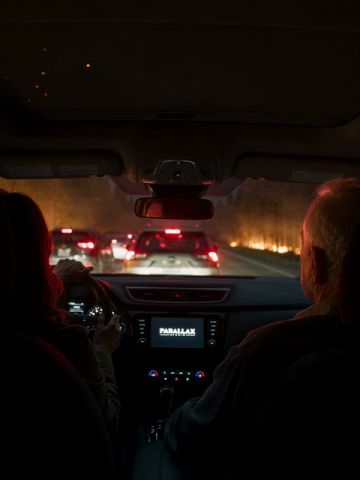
A woman around thirty sits at the wheel of a stationary car in a line of stopped traffic at night, her elderly father awake in the passenger seat beside her, wildfire burning across the landscape all around them. Ultra-realistic live-action short film, 12 seconds, 9:16 vertical, shot on Arri Alexa Mini with a 35mm anamorphic lens, Kodak Portra 400 pushed one stop, desaturated midtones. Two shots only, one hard cut, no dissolves. The car is stopped and stays stopped for the entire clip; it never moves and never restarts. Neither face is visible at any point — both are seen from behind, her dark hair at frame left and his white hair at frame right, and neither ever turns toward camera. The father sits upright and awake with his back flat against the seat back, shoulders squared, the back of his head against the headrest and his hands open in his lap — never slumped, never leaning forward, never sideways against the window, never asleep. The road is a two-lane rural road with a painted centre line, both lanes packed nose-to-tail with stationary cars all facing the same direction, out of the valley. Lighting: ember amber key from burning forest on both flanks, no fill, deep charcoal night everywhere else, with the red pulse of hazard and brake lights across the cabin. Palette of charcoal black, slate grey, bone-ash white and ember amber — the saturated red hazard and brake lights are the only saturated colour anywhere in frame. The words PARALLAX STUDIO appear in white block capitals as a static screensaver on the car's centre console touchscreen between the two front seats — self-illuminated white type on a plain black screen, centred, level, square to camera, with no map, no menus, no icons, no clock and no other interface elements; the screen stays lit and unchanging throughout and the lettering remains complete and legible. There is no coffee cup anywhere in the car. The fire never reaches the road surface and never touches any vehicle; no car is alight and no person is harmed at any point. Audio: hazard lights ticking steadily, idling engines, a low continuous roar of fire on both flanks, embers ticking on the roof, one distant car horn, one long slow exhale; the hazard ticking carries across the cut and then stops dead; no music, no score, no dialogue. Avoid showing either face, avoid the father slumping, leaning forward or sleeping, avoid either character leaving the car, avoid the car moving at any point, avoid any vehicle catching fire, avoid depicting injury or burning of any person, avoid flames on the road surface, avoid a navigation map or any interface graphics on the console screen, avoid the screen changing, flickering or switching off, avoid a single-lane or multi-lane highway, avoid two symmetrical parallel ribbons of fire hugging the road shoulders, avoid untouched dark green forest immediately beside tall flames, avoid the fire being confined to the roadside verge, avoid smoke obscuring the road in the aerial shot, avoid a true straight-down vertical aerial angle, avoid visible people in the aerial shot, avoid strobing or temporal flicker in the fire, no additional text on screen.

[0:00-0:07] Locked in the rear seat, camera low, looking forward between the two headrests. The car is stationary. Her hands rest on the wheel; her father sits upright beside her, back against the seat, head against the headrest, awake and looking straight ahead. Between them the console screen glows in the dark cabin, the white lettering clean and square to camera. Through the windshield a two-lane road runs away into the dark, both lanes packed with stopped cars, red brake lights receding in two parallel chains, none of them moving. Beyond the shoulders on both sides the forest is fully involved in flame, amber light pulsing into the cabin from left and right, embers drifting down and ticking on the roof. Smoke rolls low across the asphalt. Nothing on the road is alight. They reach toward each other across the console, her hand finding his, and she leans across and settles her head onto his shoulder. He does not move. One long slow exhale. Camera never moves.

[0:07-0:12] Cut. High steep aerial looking down at the road from above and slightly ahead, no people visible anywhere. A two-lane road cuts through dense pine forest, both lanes packed nose-to-tail with stationary cars, brake lights and hazards glowing in two long unbroken chains running off both edges of frame. The fire owns the whole landscape and is deliberately asymmetric: on the left flank a solid crown fire runs unbroken through the canopy to the far horizon, whole stands of pine fully alight from base to crown; on the right flank it is patchier and deeper, tongues of flame pushed far inside the treeline with isolated spot fires burning hundreds of metres back from the road, glowing in the dark between the trunks. Far up the road, near the vanishing point, the fire has already crossed from one side to the other. Heavy smoke drifts away to one side, leaving the road itself clear to see. One car in the middle of the line blinks its hazards alone. The camera rises slowly and steadily until the road and the fire both run past the edges of frame. The hazard ticking stops. Hold in silence.

While you're here

See What These Turn Into.

Prompts are the easy part. The reel is where the directing shows up.